MOBIAS · Strategy realisation
The highest value of an architect is the deliberate realisation of strategy.
And where there isn’t one yet, the first work is crafting it.
“If you don't know where you're going, all roads will take you there.”

Most architecture advice starts with the roads. It maps options, draws diagrams, and compares tools. None of that helps until someone has decided where the organisation is going, because a direction is what makes one road better than another. Without a direction there is nothing for an architect to realise.
So this is where MOBIAS starts. Strategy is the compass and architecture is the journey to where it points, and the two go together: the compass names the destination and orients the people who have to reach it, while the journey is the route you plan from where you stand and the deliberate work of travelling it without drifting off. One names north. The other gets you there.
How holds the design together; why explains it. The journey is run with real instruments. From your strategy and capabilities comes a target operating model; a pace-layered capability map steers structure and investment; OKRs, KPIs and CSFs steer behaviour toward the goal. Every metaphor below sits on a method like this one.
Direction
A strategy lets your whole organisation decide well without being told each time.
“If you mistake marketing for strategy, the whole organisation is inclined to make the wrong decisions, and you end up having to micromanage everything.”
A real strategy works as shared intent. Once people across the organisation hold the intent, they choose well on their own, without escalating every call. So the test of a strategy is simple: does it steer behaviour, or does it only describe an ambition?
A deck that impresses the board and changes nothing on Monday is the second kind. It looks like a strategy and works like decoration. The harder failure is subtler: a plan so ambitious it isn’t honest about how the place actually runs. Even the person who wrote it breaks from it daily, every contradictory call steers everyone else wrong, and the only way left to hold the line is to decide everything yourself. The honest fix is to publish the realistic strategy you will actually follow, so the people downstream can follow it too.
Get that right and you can do the opposite of micromanaging: push real authority down to the people closest to the work, because they already share the intent.

The published directionIt reads well. But it doesn’t account for reality.
So she applies the real plan by handThe honest version lives in her head, so she fixes each decision herself.
One person, deciding for everyone, all day.
Write the strategy you’d actually follow, and each of them chooses it.
Mean what you publish, and the organisation steers itself.
A federal health insurer’s leadership wanted more value from architecture and brought Kurt in as Head of Architecture to deliver it. He co-authored the IT strategy with the CIO on a COBIT base, then built the architecture capability to realise it. case study →
Preparation
You can’t avoid what you can’t see. But look closer, and most of it is there to find.
“The hardest part of any journey is planning for what you can’t yet see. Most of it you can find before you set out.”
A goal you can see is not a road you can trust. From where you stand the way north looks open and the straight line looks fast. It rarely is. The first bridge you reach can land you on the wrong side of the river, and the easy open stretch is often where the ground gives no warning.
Most of the risks that stop a programme were there to be found before anyone set out: the dependency no one drew, the constraint that only shows under load, the cost that lands two years on. A few dangers are genuinely unknowable, and those nobody can plan around. The larger share are simply the ones no one looked closely enough to catch while there was still time to act.
So before the journey starts, architecture reads the terrain. The strategy names north; the map fills in the ground between you and north and draws the route that actually arrives. It doesn’t argue with the direction. It plans the route honestly against what the terrain shows, so the strategy survives contact with the ground and the organisation can carry it out.
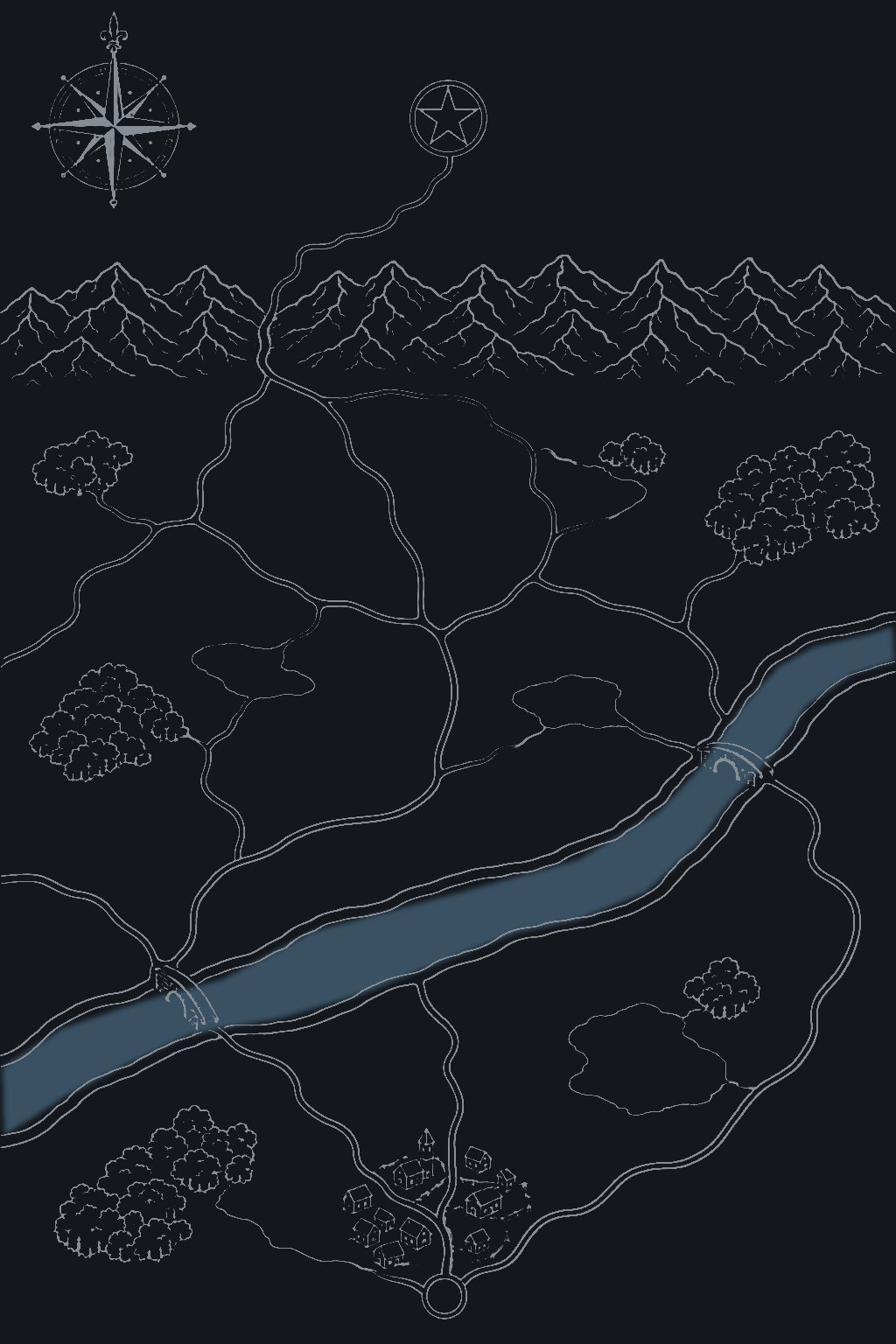
Two carts, one road north.
The city sits due north, and the compass agrees. What it can’t tell Deliberate Dan or Lucky Liam is what waits between here and there.
North felt like the fast way to Lucky Liam.
So Lucky Liam kept to the straightest line and crossed at the first bridge he found. A road rarely runs straight to where you’re going.
Deliberate Dan had seen the turn before he made it.
One gap through the mountains, far to the left. He had it on his map before he set out, which is why he crossed early and gave up some north.
The open road kept its own secrets.
Bandits were waiting where the ground gave Lucky Liam no warning. They took his cart and left him the road home, his life and nothing else.
Deliberate Dan reached the city with his cart full.
He’d read the bandits on the map and given up some north to route wide of them. He sold his goods and provided for his family.
A national customs administration ran its own implementation of an EU-mandated modernisation programme, to deadlines the EU set and the larger states kept moving. Kurt came in as interim programme & portfolio manager over a set of interlocking projects, with a legacy system being replaced while it stayed live, where one slip could cascade through the rest. An integrated schedule and formal dependency tracking made the cascade visible early, so every time the dates shifted the dependencies could be re-evaluated and the plan re-drawn in days. case study →
Priority
A competent answer solves the problem. The architect finds the best one for this context, now.
“You spend each euro and each hour once, and your best people can only be in one place. The only question that matters is where.”
Once there is a destination, the next question is what you spend to reach it. The money, the time and the people you can put on the work are all limited at once, and none of them buys back another: you can’t reliably trade budget for a deadline, and adding people to a late effort usually makes it later. Every choice also gives something up elsewhere. Maintainability and heavy reuse cost execution speed; a page built for one kind of user reads wrong for another. Because you can’t fund everything at once, scarcity rarely means a thing never gets done. It means it doesn’t get done now, and priority is the clear order of what comes first and what waits.
Finding a workable option is the easy part, and most experienced people manage it. Finding the option that serves your strategy best, given your context right now, is the harder thing, and it’s the difference between an answer and the right answer. The strategy is what tells you which call is the right one. Without it you are optimising in a vacuum.
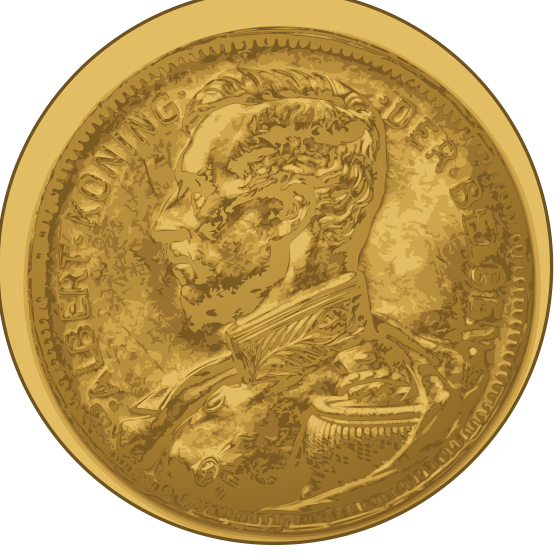
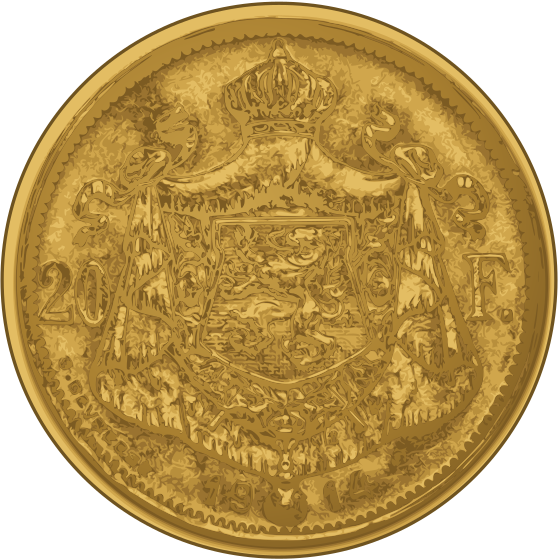
Optimize the partThe palace is the showpiece. But it lights only itself.
Optimize the wholeWhat if we funded the unglamorous plant that makes the biggest difference?
Money can only be invested once.
Placed in the core, one coin runs the whole city.
Every coin spent elsewhere weakens the goal.
At a payroll and HR services group, a crisis-bound legacy product had to become sellable into public tenders. Every move answered one commercial goal as a deliberate trade-off: secure enough to qualify, cheap enough for municipal budgets, fast enough to demo, and predictable enough to deliver. The budget could only be spent once, so every decision was made against the goal it served. case study →
Discipline
Hold the line on purpose; nobody holds it perfectly.
“The tactical decision tastes like cookies. But cookies don't get you where you want to be. Discipline does.”
A strategy is like a diet. The results come only if you hold to it. Say you’ll lose weight and then eat cookies every day, and the diet was never steering anything. It was marketing. A strategy that loses to the easy call every week is the same.
Here is the cost. Every easy call you didn’t have to make loses you time toward the goal and leaves something behind, so the next decision starts from a worse place with the earlier shortcut still to clean up. That backlog is debt, and you keep servicing it until you clear it. Holding the line is genuinely hard, because the obstacles keep arriving and the tactical call is almost always the easier one. The ideal is relentless intent to stay on the chosen road. Nobody hits it perfectly, and the occasional exception when there’s no other choice is human and often fine. What does the damage is the run of defensible small ones, each compounding on the last.
Holding the line is not rigidity. The goal itself can genuinely shift, and when it does the ground you already covered isn’t wasted: at every step you were following the goal as it stood. The discipline is to follow the strategy you have now wholeheartedly, which is a different thing from following one strategy forever.



The same programme met European deadlines it could not relax and could not hold still, on a fraction of a larger state’s budget, by governing the scarce things by risk. Kurt set a risk-based test pyramid that bought the highest-risk coverage first, and phased the lowest-risk long-tail scenarios to after go-live as a deliberate, risk-assessed choice. The deadline was met, and where the line bent was documented. case study →
Control
Every decision forecloses others. A decision that carries its why is one you can revise.
“Knowing why a decision was made is as important as that it was made. The why is what tells you when to revise it: when the conditions it was taken under have changed, or it has proven ineffective.”
The earlier sections promise that MOBIAS will orient you, pick the right trade-offs and help you hold the line. That promise carries one fair worry: what happens to all those calls when one turns out wrong, or the world moves under it?
That worry is what the record answers. Each significant decision is written down with the context it was taken in, the assumptions it rests on and what it gave up. The record earns its keep by making the decision revisable: it names the exact conditions under which the decision should change, so when an assumption stops holding you can see it and act. The same record tells you how far back to go. Most changes re-enter the work at the lowest level that owns what shifted, and climb higher only when they break an assumption a higher level depends on. You revise at the altitude the change belongs to, instead of reopening the whole strategy every time something moves.
Architecture lays the trade-offs out at the right altitude for each level of the organisation, and the accountable owner makes the call. The architect’s job is to make that call a good one and a revisable one. That is how you stay in control of your own decisions, rather than handing them to a document.
context
the conditions the decision was taken under
assumptions
what it rests on, and would change if untrue
revise when ↻what we gave up
the options this call foreclosed
A federal mapping agency. An org-wide capability map gave the board of directors a single view of where the organisation stood and where it had to go. The directors scored the gaps and chose the priorities themselves, and on that map they approved the roadmap, the funding and the operating model, which then cleared the federal oversight board. Kurt led the first months of putting it into effect, alongside the agency’s head. The decision stayed the directors’; the record made it a call they could revise as the ground moved. case study →
Fit
The method is the first thing your strategy decides.
“Your strategy and your capabilities shape the operating model. A capability map steers structure, flow and investment. OKRs, KPIs and CSFs carry the direction to the people making daily decisions.”
The pictures above carry the idea. Here is the method underneath them. Strategy and architecture work as one piece: the strategy names where you’re going, and the way you organise the journey to get there is itself an architecture decision, taken from your strategy and your context. So there’s no house playbook. The right way to run an engagement is the first thing the strategy decides, and the diagram below is one example of how the pieces connect.
From a strategy and its capabilities comes a target operating model. A pace-layered capability map, stable foundations through to innovative edges, set against people, process, information and technology, steers structure, flow and investment. OKRs, KPIs and CSFs steer behaviour, so the direction reaches the people making daily decisions. The same logic ran behind the engagements on this page, each one shaped to the organisation it served.
One example of how the pieces connect. The approach is designed to your strategy, frameworks and context.
MOBIAS helps organisations make the right decisions for the goal.